Cardinality Studies
2026
This section looks at how Xylem handles numbers, or more precisely cardinality, making an exact count of something. Counting is one of the hardest things you can ask an image model to do. These models don't tally. They see a scene as texture rather than separate things, so they lose track of how many, giving you "some" of a thing rather than the number you asked for.
Xylem is no different here. Asked for ten of something, it tends to produce a plausible scattering, enough to read as a group but rarely the right count. What comes back isn't really counted. It's more like the impression of a number.
Each prompt pushes at a different point in the breakdown. A handful, where the model can sometimes hold two or three. Ten, around where its sense of number starts to give out. A hundred, well past the point of counting, where it stops tallying and just renders a field. The same subject across counts, so the only thing changing is how many.
As with everything Xylem makes so far, these come back deep in colour collapse. The model can't hold natural, in-between colours, so every tone snaps to a harsh extreme of magenta, green, black or white. Those four are the corners of the colour space digital images are built from, which makes them the emptiest place in real photography and the one thing a broken model falls back on.
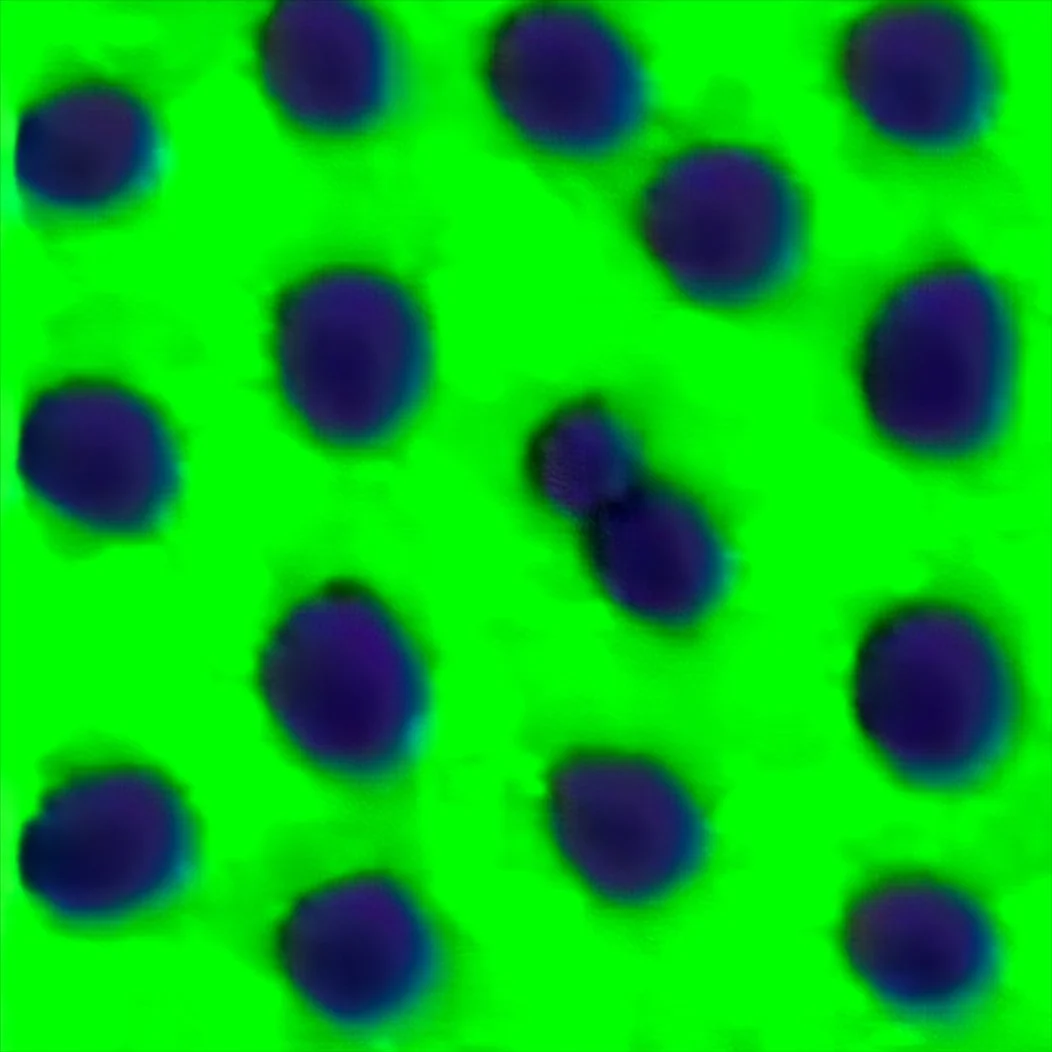
10 Dots (Telomere 1.0), 2026
100 Dots (Telomere 1.0), 2026
Every image created in Xylem starts as pure noise, a field of random static. Over 100 steps the model clears the noise away, nudging the mess closer to the prompt, in this case different requests for characters, until something is left. What emerges are dots of sorts, still deep in colour collapse. The model doesn't draw. It surfaces an image from static, nothing entering from outside.