Frame Rate
1995 - 2000
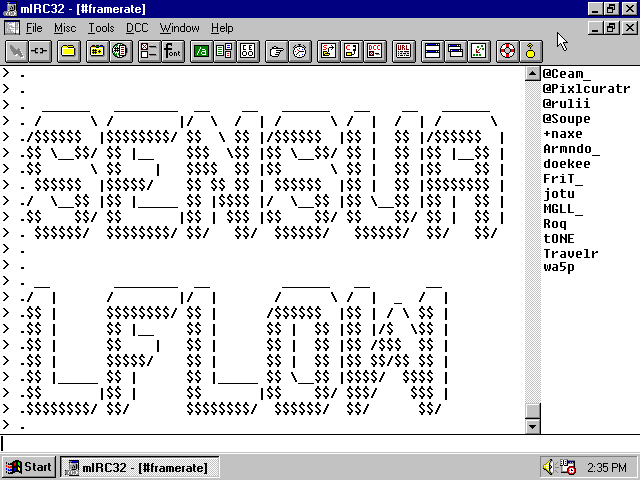
Frame Rate was an online art space Shannon Novak started in 1995 while living in Taranaki. It's one of the earliest online art spaces in Aotearoa New Zealand, set up just as dial-up internet became available to the general public. It wasn't a website. It was a channel on IRC (Internet Relay Chat) called #framerate, reached through mIRC, a Windows chat client first released in February 1995. It ran until 2000.
The screenshots that follow show the channel in use. Names in the right-hand list marked with @ are channel operators, the people who ran the space, Novak among them. The + marks a voiced user, someone given a raised status within the room. Everyone else sits below. The main window is where the work happened.
People came to #framerate to experiment, test ideas and show new work. ASCII and text pieces were pasted straight into the chat, scrolling past like a live feed. Image files of the day, GIFs and JPEGs, were swapped person to person using mIRC's direct file transfer. Scripts were part of it too. mIRC had its own scripting language, so a work could be a set of instructions that made the channel do something.
The logo
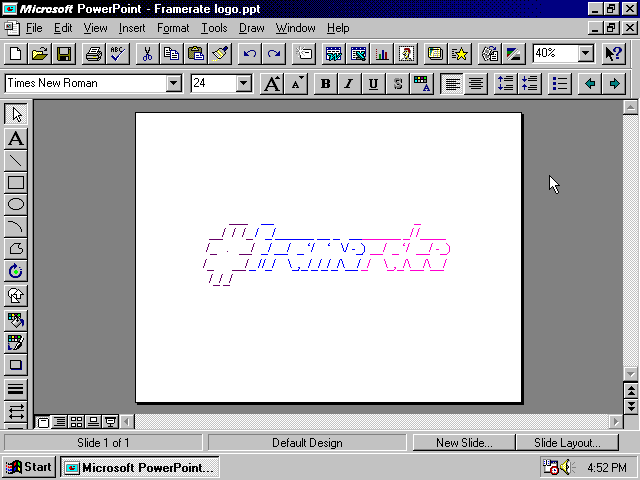
Frame Rate had a logo, made in Microsoft PowerPoint to match the channel name. It uses three colours. Blue and pink, the colours handed out by gender, mix to make purple, a step beyond tradition. The # holds it together. On IRC that symbol is what makes a channel a channel. Without it, there's no room to gather in.
Context
New Zealand's first online art spaces appeared in the mid-1990s. They were built around dial-up connections and slow downloads, and ran on a culture of exchange before the web turned commercial. Spatial State of A and B, launched in 1996, was the country's first dedicated online gallery. It was made for the browser, with HTML and hyperlinks forming the exhibition itself rather than a page of opening hours and photos of paintings. In 1997 Codec, coordinated by Danny Butt, became New Zealand's first national online contemporary art project. It linked four galleries around the country and commissioned new work for the web between them.
Frame Rate came before both. It sat outside the web and outside the gallery system, in a chat channel. It ran until 2000. By then the web page had become the main place for art online, and spaces built for the browser drew the attention that chat channels once had.